


Storing firewood properly helps your logs stay dry, burn cleaner, and give out better heat. Making the most out of your log burner.
If logs are stored badly, they can absorb moisture, grow mould, attract pests, and become harder to light. Damp wood also creates more smoke, blackens stove glass faster, and can lead to more soot and deposits in your chimney or flue.
The simple rule is this:
Store your main firewood supply outside, raised off the ground, covered on top, and open at the sides so air can move through the stack.
Firewood should have a moisture content of 20% or less before you burn it.
This matters because wet wood wastes energy. Instead of producing useful heat, part of the fire’s energy is used to boil off the water inside the log. That means less heat in the room, more smoke, and a more frustrating fire.
The easiest way to check is with a moisture meter. Split a log, test the freshly exposed face, and look for a reading of 20% or below.
When buying logs, look for the Ready to Burn logo. This shows the wood has been certified as suitable for immediate use.
Dry kindling helps a fire catch quickly, but splitting smaller pieces from larger logs with an axe can be awkward and difficult to control.
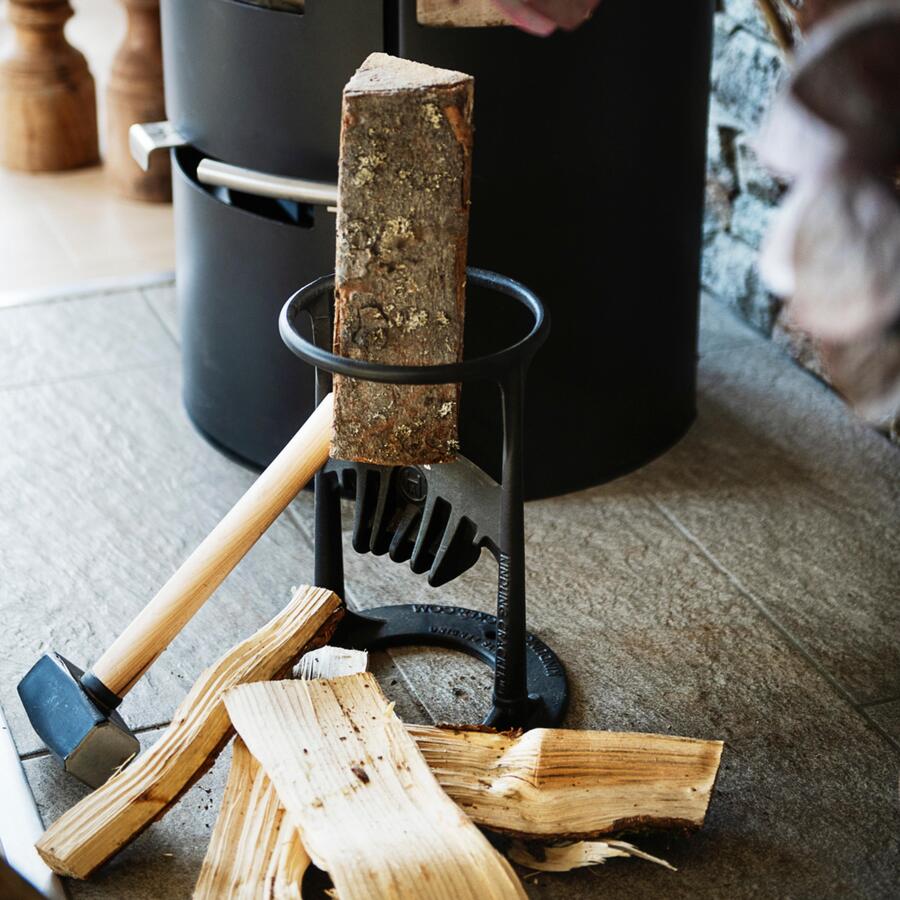
The fixed blade gives you a safer, more controlled way to split kindling from larger logs.
A Kindling Cracker Premium Bundle keeps the blade fixed in place. You place the wood inside the ring and strike it from above, giving you a safer and more controlled way to prepare kindling without swinging an axe.
Learn more about the Kindling Cracker Premium Bundle →
The best place to store firewood is outside in a dry, well-ventilated spot.
A proper log store is ideal because it keeps the rain off while still letting air move around the logs. A sheltered wall, garage opening, carport, lean-to, or covered area can also work, as long as the wood is not trapped in a damp, closed space.
Avoid storing your main log supply in a fully sealed shed with poor airflow. Firewood needs ventilation. If air cannot move through the stack, moisture can stay trapped and the logs may not dry properly.
Yes. Firewood should be raised off the ground.
If logs sit directly on soil, grass, paving, or concrete, they can absorb moisture from below. This can slow drying, encourage rot, and make the bottom layer of logs unusable.
Use a log store, pallet, rack, rails, bricks, or timber bearers to lift the logs and allow air underneath the stack.
Even a small gap is better than stacking logs straight on the ground.
You can cover firewood with a tarp, but only cover the top.
The mistake is wrapping the whole stack tightly. That can trap moisture inside and stop the logs from drying. Firewood needs airflow, so the sides should stay open where possible.
The best setup is:
Cover the top to keep rain off.
Leave the sides open so air can move through.
Keep the stack raised off the ground.
Avoid letting the tarp sit tightly against the logs.
A roofed log store is usually better than a loose tarp because it protects the wood without blocking airflow.
Firewood should be stacked neatly with enough gaps for air to move through.
Do not throw logs into a heap and leave them. A messy pile traps moisture, dries unevenly, and can become unstable.
Stack logs in rows with the cut ends facing out where possible. Keep the stack tidy, but do not pack the logs so tightly that air cannot pass between them.
If stacking against a wall or fence, leave a gap behind the logs. This helps air circulate and stops moisture being trapped between the wood and the surface behind it.
You can store a small amount of firewood indoors, but your main supply should usually stay outside.
Only bring in what you expect to burn soon. A small log basket near your stove can be useful, but large amounts of firewood should not be stored inside the house.
Keeping too much wood indoors can bring in insects, mess, moisture, and mould spores. Logs should also be kept a safe distance away from your stove, open fire, or any other heat source.
A good rule is to bring in enough wood for the next day or two, then top it up as needed.
If you have space, keep your main firewood stack away from the house wall.
This helps reduce the chance of pests moving from the log stack into your home, and it also improves airflow around the wood.
If you need to store logs near a wall, avoid pressing them tightly against it. Leave a gap so air can move behind the stack.
Do not store logs right next to your stove or fireplace. Indoor logs should be kept in a suitable basket or rack, away from direct heat.
Freshly cut wood can take a long time to dry properly.
The exact time depends on the wood type, log size, weather, airflow, and how it is stacked. Some logs may take many months to dry. Others may need a year or more.
The safest answer is not to guess by time alone. Check the moisture content.
If the log is 20% moisture or less, it is generally ready to burn. If it is above that, it needs more drying time.
Wet firewood is usually harder to light and gives off less heat.
Common signs include:
The logs feel heavy for their size
The ends have few or no cracks
The bark is damp or loose
The wood hisses or bubbles when placed on the fire
There is lots of smoke
The stove glass blackens quickly
The fire struggles to stay lit
A moisture meter is still the best way to check. Some logs can look dry on the outside while still holding moisture inside.
Yes. Use older logs first.
When stacking firewood, try to keep the oldest logs easiest to reach. This helps stop older wood sitting at the back of the store for too long while newer deliveries are used first.
A simple system works best:
New logs go to one side or the back.
Older logs stay at the front.
Use the driest, oldest logs first.
This keeps your firewood supply easier to manage and reduces waste.
Avoid these common mistakes:
Storing logs directly on the ground
Wrapping the full stack in plastic or tarp
Keeping logs in a sealed, damp shed
Stacking logs too tightly
Leaving logs in a loose heap
Pressing logs tightly against a wall
Bringing too much firewood indoors
Storing logs too close to the stove
Burning wood before it reaches 20% moisture or less
Most firewood problems come down to the same issue: too much moisture and not enough airflow.
Good firewood storage is simple.
Keep your logs dry.
Raise them off the ground.
Cover the top.
Leave the sides open.
Let air move through the stack.
Only bring a small amount indoors.
Burn wood at 20% moisture or less.
Do this, and your firewood will be easier to light, cleaner to burn, and better for your stove.